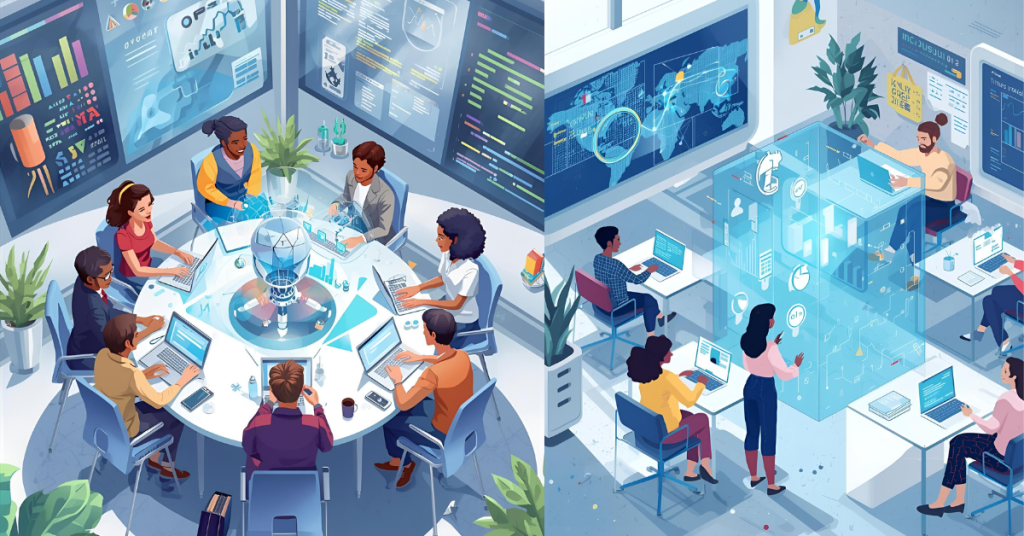
Artificial Intelligence isn’t just a futuristic buzzword anymore—it’s the core engine reshaping global education, industries, and employment. The AI impact on student jobs will be one of the most significant transformations of the decade, changing how students learn, work, and earn by 2030.
In the past, graduates entered a predictable market—engineering, medicine, management, or teaching. But by 2025, the rise of AI-driven automation has already rewritten those expectations. According to the World Economic Forum’s Future of Jobs Report (2025), nearly 44% of workers’ skills will be disrupted by AI adoption, while 97 million new AI in the workplace will emerge.
This transformation isn’t limited to the tech industry. Every student—from business majors to art students—will feel the effects of this evolution. The next five years will determine who adapts successfully to this new world of intelligent systems.
How AI Is Already Influencing Education and Student Life
AI’s biggest impact starts long before students graduate. The intersection of AI and education has created a new era of personalized, data-driven learning.
Students today use AI-powered tools to manage schedules, conduct research, and improve writing. For instance, the AI Semester Planner helps automate study planning, ensuring better time management and productivity. Similarly, resources like AI Tools for Learning New Subjects show how learners can master new fields faster using adaptive AI tutors.
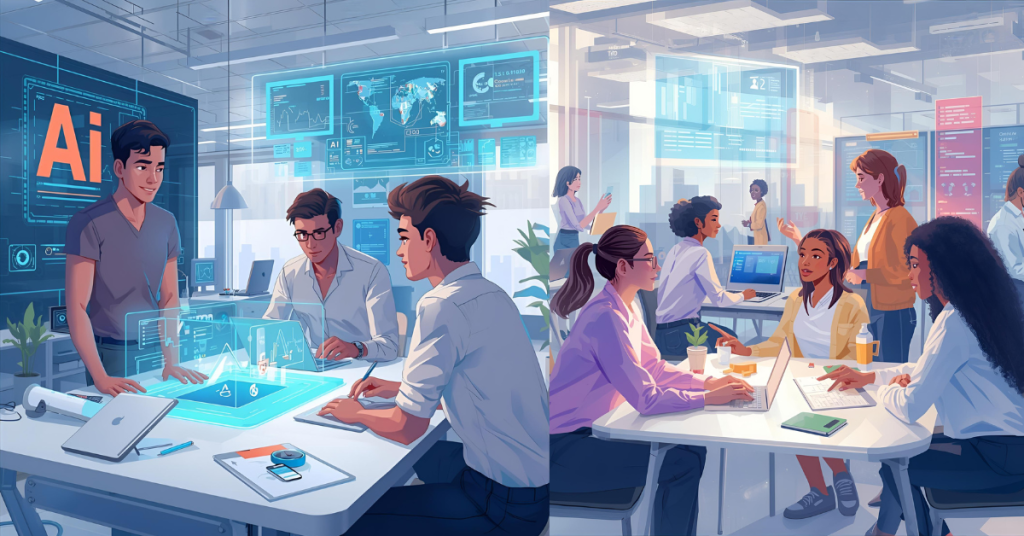
AI not only boosts efficiency—it develops early familiarity with the systems dominating workplaces. Students leveraging these tools are already building critical AI skills for students, preparing them for tomorrow’s professional environments.
The Future Job Market: What Will Change by 2030
The next five years will see the rise of AI in the workplace across all sectors. Automation will affect routine, repetitive roles first—but simultaneously create demand for creative and analytical thinkers who can manage, interpret, and enhance AI systems.
Automation Will Redefine Entry-Level Roles
Data entry, basic analytics, and administrative tasks will become automated. However, this doesn’t signal fewer opportunities; it signals a shift in focus. Students entering the workforce will manage the technology rather than perform the repetitive labor it replaces.
Growth of Hybrid Roles
The line between technical and non-technical jobs is fading. Marketers now use AI for audience insights; teachers use it for personalized instruction; and designers use tools like Midjourney and Adobe Firefly to co-create. As described in Use AI for Creative Projects, creativity combined with AI literacy is the new professional advantage.
Rise of New Job Titles
Emerging roles such as AI Prompt Engineer, Data Quality Analyst, and Machine Learning Associate will dominate graduate job boards. Students with hybrid skill sets—data interpretation plus creative thinking—will be the most employable.
By 2030, nearly 60% of all jobs will require at least basic AI familiarity, according to Harvard Business Review’s 2024 analysis on AI transformation. That’s why understanding the AI impact on student jobs is essential now—not later.
Industries Growing Because of AI
Contrary to the fear of job loss, several industries will expand thanks to AI integration.
a. Education Technology (EdTech)
AI tutors, adaptive assessments, and personalized learning platforms are reshaping education. Students interested in AI and education can pursue roles in instructional design, algorithm training, or AI curriculum development.
b. Healthcare and Bioinformatics
AI’s ability to analyze vast datasets is accelerating medical research. Students with technical or scientific backgrounds can enter roles in diagnostic AI modeling or healthcare data analysis.
c. Marketing and Communication
Creative industries are thriving under AI. From automated ad campaigns to trend forecasting, marketers who understand AI in the workplace are more valuable than ever.
d. Environmental and Agricultural Technology
AI is solving real-world sustainability issues—predicting crop yields, reducing waste, and managing energy resources. Students in environmental sciences or engineering can work in green-AI startups that combine innovation and impact.
The Essential AI Skills for Students in 2025–2030
The AI revolution isn’t just about coding—it’s about understanding how technology augments human intelligence. These AI skills for students will define the next generation of professionals:
- AI Literacy – Understanding how AI models work and what their limitations are.
- Prompt Engineering – Knowing how to communicate effectively with AI tools like ChatGPT or Gemini to produce accurate outputs.
- Data Fluency – Learning to analyze and interpret datasets through Excel, Python, or Power BI.
- Critical Thinking – Evaluating AI-generated information rather than accepting it blindly.
- Ethical Awareness – Understanding AI bias, data privacy, and responsible usage.
- Adaptability – Rapidly learning new AI platforms and workflows as technology evolves.
Students can begin their journey with platforms such as Google Career Certificates in AI, Coursera, or community resources outlined in Monetize AI Knowledge, where they can also learn how to turn AI expertise into income streams.
How AI in the Workplace Will Change Career Expectations
Employers no longer want traditional resumes—they want proof of adaptability. The AI impact on student jobs means recruiters now value portfolios that demonstrate the ability to use AI strategically.
AI-Assisted Productivity
Graduates who use AI for automation and time management outperform peers. Using planners, writing tools, or research AIs shows employers that you’re efficient and tech-ready.
Data-Driven Decision Making
AI tools help professionals extract insights faster. Whether it’s marketing analytics or HR predictions, data-literate employees make better decisions.
Collaborative Intelligence
Teams are shifting toward “human + AI” workflows. Students who can seamlessly collaborate with AI—co-writing, analyzing, and designing—will fit naturally into modern workplaces.
Continuous Learning Culture
Because AI evolves rapidly, the workplace rewards curiosity. Following organizations like UNESCO’s AI in Education Initiative (link) ensures students stay informed about ethical and educational developments.
How Students Can Prepare for AI-Driven Jobs
Preparing for the future is simpler than it seems—if done intentionally. Here’s how students can prepare for AI and ensure long-term employability:
- Experiment with Tools – Use AI for notes, research, and creativity. Every experiment builds practical understanding.
- Build an AI Portfolio – Include case studies, automated workflows, or chatbot experiments in your portfolio.
- Learn AI Ethics – Understand fairness, bias, and accountability to stand out in interviews.
- Collaborate Online – Join platforms like Kaggle or LinkedIn AI groups for networking.
- Stay Updated – Read thought-leaders such as the Harvard Business Review and the World Economic Forum to track global AI trends.

The students who continuously learn and adapt will thrive despite disruption.
Pros and Cons of AI for the Student Job Market
| Pros | Cons |
|---|---|
| Increases efficiency and reduces repetitive work | Replaces some entry-level administrative jobs |
| Creates new hybrid roles | Demands constant learning and reskilling |
| Improves access to remote and freelance work | Raises ethical and privacy challenges |
| Boosts creativity through automation | Can widen digital skill gaps |
Ultimately, the AI impact on student jobs isn’t about replacement—it’s about redefinition. Those who learn how to work with AI will secure more flexible, higher-value roles than ever before.
Predictions: The Next Five Years for Students (2025–2030)
Here’s what experts and data predict for the near future:
- AI will be as common as Excel – Every role will expect basic AI competence.
- Recruiters will test AI literacy – Interview tasks will include prompt writing or AI problem-solving.
- AI internships will emerge – Students will assist organizations in training or testing AI systems.
- Micro-entrepreneurship will rise – Many students will use AI to run online businesses or freelance services.
- Continuous learning will be non-negotiable – Skills will expire faster; adaptability will be the new degree.
A 2024 LinkedIn Workforce Report showed that job listings requiring “AI familiarity” grew 250% year-over-year, confirming how deeply AI is integrating into all career paths.
Real-World Examples of AI Empowering Students
- AI-Powered Research: Students at MIT use machine learning to summarize academic papers in seconds.
- Creative Industries: Art students collaborate with AI generators to produce professional-grade visuals.
- Entrepreneurship: Young professionals launch niche services—AI tutoring, prompt engineering consultation, and workflow automation—showing how the future jobs for students are more diverse than ever.
These examples prove that students who embrace AI early experience higher employability and creative freedom.
FAQs About AI and Student Jobs
Q1. Will AI completely replace student jobs?
No. AI automates tasks, not roles. It removes repetition so humans can focus on strategy, creativity, and emotional intelligence.
Q2. Which fields will grow most with AI?
Education technology, data analytics, healthcare, and creative industries will all expand with AI adoption.
Q3. Can non-technical students benefit from AI?
Yes. Every student can use AI for organization, communication, or productivity.
Q4. What’s the best way to learn AI skills for students?
Start with online courses (Coursera, DeepLearning.AI) and practice using tools like ChatGPT, Perplexity, and Notion AI.
Q5. Is AI knowledge more important than a degree?
Both matter. Degrees prove discipline, but AI literacy proves adaptability—the quality most valued in 2030.
Conclusion:
The AI impact on student jobs is both inevitable and exciting. It’s redefining how students approach education, skill development, and career growth. Instead of fearing automation, students must learn to lead it.
AI is not your rival—it’s your collaborator. By learning how to leverage it, you’ll multiply your career opportunities and stay ahead of change.
The next five years won’t just reward those who graduate; they’ll reward those who adapt, experiment, and evolve.
“If you enjoyed reading this blog and want more daily AI tips and productivity hacks, follow me on Instagram @galyxai and X (Twitter). I regularly share practical strategies to help students and young professionals save time and get more done every day.”